

How to Choose Between 0.15 mm, 0.20 mm and 0.30 mm CTP Plates?
Aug. 04, 2026
Choosing a CTP plate is not only about whether it is thermal, UV-CTP or CTCP. Plate thickness also affects how the plate performs during mounting, imaging, processing and long press runs.
Choosing the right CTP plate thickness is not simply a question of “thicker is better” or “thinner is cheaper.” For commercial printers, the correct choice depends on the press configuration, print run length, plate handling method, substrate size, and production environment.
At Haomei Aluminum, we often receive a simple question from printing plate buyers: “Should we choose 0.15 mm, 0.20 mm or 0.30 mm CTP plates?”
The answer depends on your press format, printing volume, handling conditions and the type of jobs you produce. A thinner plate may reduce material cost and work well on small-format presses, while a thicker plate can provide better stiffness and stability for larger formats or demanding production environments.
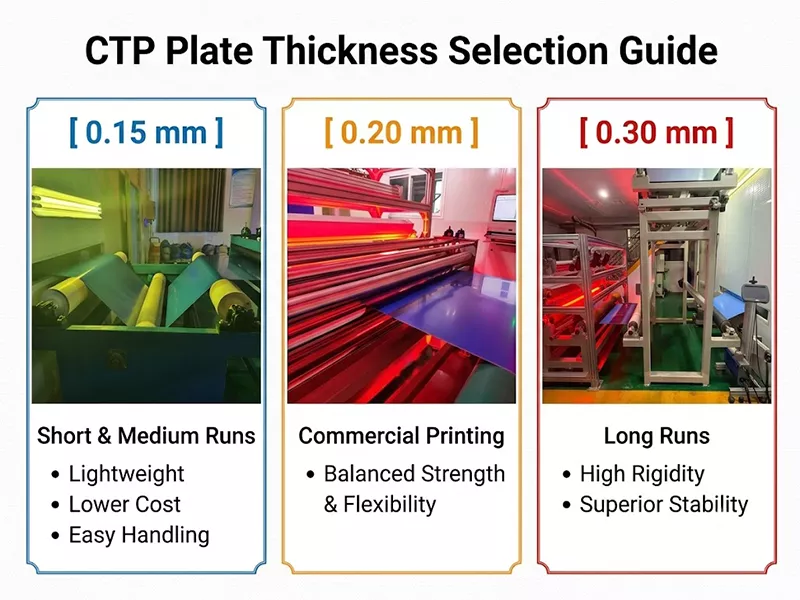
- Choose 0.15 mm CTP plates for lightweight applications, smaller formats, and cost-sensitive short-to-medium runs.
- Choose 0.20 mm CTP plates for general commercial printing and balanced overall performance.
- Choose 0.30 mm CTP plates for large-format presses, higher rigidity requirements, and demanding production conditions.
The final decision should always be based on your press model, plate size, loading system, job type, and production requirements.
Haomei Aluminum can help you select an appropriate CTP plate substrate thickness based on your technical specifications. Contact our team to discuss plate size, alloy, thickness tolerance, surface requirements, and export packaging options.
Each thickness has a practical role in printing production. Selecting the wrong gauge may lead to plate bending during mounting, registration issues, unnecessary material cost, or reduced efficiency on long-run jobs.
Why CTP Plate Thickness Is Important for Printing Performance
The thickness of a CTP plate directly affects its handling performance, press stability, and overall printing efficiency. Choosing the right plate thickness helps printers achieve better registration accuracy, smoother plate mounting, and more reliable performance under different printing conditions.
Different thickness options are designed for different printing requirements. Thin gauge CTP plates are often selected for short to medium runs where lightweight handling and cost efficiency are important, while thicker plates provide enhanced rigidity for demanding applications and longer press runs.
Key factors influenced by CTP plate thickness include:
- Improved plate stiffness and dimensional stability during printing
- Easier handling, bending and installation on the press cylinder
- Better compatibility with various offset press specifications
- Reduced risk of plate deformation during storage and operation
- Suitable performance for different print run requirements
- Lower material consumption and transportation costs when using thinner plates
As the core material of a CTP printing plate, the aluminum substrate plays an important role in image quality and plate durability. Consistent thickness control, uniform grain structure, excellent flatness, and stable anodized surface treatment provide a reliable foundation for precise imaging and consistent ink transfer.
Haomei Aluminum applies strict quality control throughout the manufacturing process, including aluminum alloy selection, thickness tolerance control, electrochemical graining, anodizing treatment, and coil flatness inspection. These processes help ensure that each CTP plate delivers stable performance from prepress imaging to final printing.
0.15 mm vs. 0.20 mm vs. 0.30 mm CTP Plates
| Plate Thickness | Typical Application | Main Advantage | Main Consideration |
| 0.15 mm | Small-format presses, short-to-medium runs, cost-sensitive jobs | Lightweight and economical | Lower stiffness; requires careful handling |
| 0.20 mm | Commercial printing, sheet-fed offset, general-purpose applications | Balanced cost, strength and compatibility | May not be ideal for very large-format or highly demanding jobs |
| 0.30 mm | Large-format presses, packaging printing, long runs and demanding environments | Excellent rigidity and handling stability | Higher material cost and weight |
Explore our full range of CTP plates for thermal, UV-CTP, and violet CTP products.
Users viewing this material also viewed the following
When to Choose a 0.15 mm CTP Plate
A 0.15 mm CTP plate is designed for printers who need a lightweight, economical aluminum plate solution for short and medium-run offset printing. Compared with standard 0.30 mm plates, the thinner substrate reduces aluminum usage while maintaining reliable imaging performance for suitable press conditions.
This thin gauge CTP plate is commonly chosen for applications where production flexibility, lower plate cost and easier handling are more important than maximum mechanical strength.
Typical applications include:
- Small and medium-size sheet-fed offset printing presses
- Short-run commercial printing projects
- Local and regional printing companies
- Flyers, brochures, manuals, forms and promotional materials
- Printing operations with frequent plate changes and moderate production demands
Due to its reduced aluminum thickness, the 0.15 mm CTP plate offers advantages in material consumption, transportation efficiency and storage space. It is especially suitable for printers looking to optimize plate costs without compromising normal commercial printing quality.
Key Advantages of 0.15 mm CTP Plates
Cost-efficient aluminum consumption The thinner aluminum substrate requires less raw material compared with thicker CTP plates, helping reduce plate purchasing costs for high-volume plate users.
Lightweight and easy to handle With a lower plate weight, 0.15 mm CTP plates are easier to transport, store and mount, making them practical for smaller offset presses and daily production environments.
Reliable printing performance for commercial jobs When used under suitable press conditions, a high-quality 0.15 mm CTP plate can deliver accurate image transfer, stable coating performance and consistent print results for short and medium production runs.
What to Consider Before Selecting 0.15 mm CTP Plates
The thinner substrate provides economic benefits, but it also has lower rigidity compared with 0.20 mm or 0.30 mm CTP plates. During handling, storage and mounting, extra care may be required to prevent bending, scratches or edge deformation.
For large-format presses, high-speed production lines or extended print runs, thicker CTP plates may provide better dimensional stability and mechanical support.
Haomei Aluminum typically recommends 0.15 mm CTP plates for customers with the following requirements:
- Small or medium press formats
- Short to medium printing runs
- Frequent plate replacement during daily production
- Focus on reducing plate cost and transportation expenses
- Normal operating conditions without excessive mechanical stress
As an aluminum substrate manufacturer, Haomei Aluminum supplies CTP plate aluminum sheets and coils with controlled thickness, flatness and surface quality for different plate-making requirements. Customized solutions are available based on alloy selection, temper, surface treatment and customer production specifications.
When to Choose 0.20 mm CTP Plates
For most commercial printers, 0.20 mm is the practical middle ground. It offers noticeably better rigidity than 0.15 mm while remaining cost-effective for everyday sheet-fed offset printing.
This thickness is widely used for:
- Medium-format sheet-fed offset presses
- Commercial printing plants
- Book, magazine and catalog printing
- Advertising materials
- Corporate brochures and stationery
- General packaging and label work
- Plate distributors serving a broad customer base
Why 0.20 mm Is Often the Standard Choice
A small increase in thickness can create a meaningful increase in stiffness. In theory, the bending stiffness of a metal sheet rises approximately with the cube of its thickness.
That means a 0.20 mm plate can be substantially more rigid than a 0.15 mm plate, even though the difference in thickness appears small. This additional rigidity helps reduce the risk of deformation during transport, loading and press operation.
Advantages of 0.20 mm CTP Plates
- Balanced strength and cost: Provides a practical balance between aluminum consumption, plate rigidity and overall printing performance.
- Wide press compatibility: Suitable for many standard commercial offset press configurations and commonly used printing workflows.
- Better handling durability: Compared with 0.15 mm CTP plates, the 0.20 mm thickness offers improved resistance to bending, deformation and handling damage.
- Efficient inventory choice: A popular thickness option for distributors, plate suppliers and printers because it meets a wide range of general commercial printing requirements.
When to Choose 0.30 mm CTP Plates
A 0.30 mm CTP plate is designed for applications where stiffness, durability and handling stability are more important than minimizing substrate cost.
This thickness is often selected for:
- Large-format sheet-fed offset presses
- Packaging printing
- Carton, corrugated and specialty print applications
- High-volume printing facilities
- Long or demanding production runs
- Operations where plates are transported, stored or handled frequently
- Pressrooms where greater plate rigidity is preferred
Why Choose a Thicker 0.30 mm Plate?
A 0.30 mm plate is significantly more rigid than a 0.20 mm plate. This added stiffness can improve confidence during plate mounting and reduce the chance of plate distortion caused by handling, clamping or challenging press conditions.
For large-format presses, plate stability becomes more important because the plate area is larger. A small bend or deformation that may be manageable on a small plate can become more problematic on a larger plate.
Advantages of 0.30 mm CTP Plates
- High rigidity: The thicker aluminum substrate provides excellent resistance to bending, creasing and deformation during handling, mounting and printing.
- Suitable for larger press formats: The increased plate thickness offers better dimensional stability for large-format offset presses and demanding printing applications.
- Reliable performance in demanding production environments: Designed for intensive printing schedules, frequent plate handling and applications where additional mechanical strength is required.
- Ideal for packaging and industrial printing: Provides stable plate performance for packaging applications, large-format jobs, heavy ink coverage and complex press conditions.
How to Choose the Correct CTP Plate Thickness
Selecting the right CTP plate thickness is an important step in achieving stable printing performance and controlling production costs. The ideal thickness depends on your press specifications, plate size, printing volume, and operating environment.
Before purchasing CTP plates, consider the following key factors to ensure the selected aluminum substrate matches your printing requirements.
Check Your Printing Press Specifications First
The printing press manufacturer’s specifications should always be the starting point when selecting a CTP plate gauge. Different press models may require specific plate thickness ranges to ensure proper clamping, punching, bending, and cylinder installation.
Choosing a plate that is too thin or too thick may affect plate mounting accuracy, machine compatibility, or daily operating efficiency. A lower purchase price does not always mean a better choice if the plate does not match your equipment.
If you are uncertain about the suitable specification, provide your press model, plate dimensions, and printing requirements to Haomei Aluminum. Our team can help recommend an appropriate CTP plate thickness and substrate solution.
Match Plate Thickness with Press Format
The larger the printing format, the greater the demand for aluminum plate rigidity and dimensional stability. A suitable thickness helps reduce bending, deformation, and handling damage during plate installation.
- Small-format offset presses: 0.15 mm or 0.20 mm CTP plates are commonly selected for lightweight handling and cost-efficient production.
- Medium-format commercial presses: 0.20 mm CTP plates provide a balanced combination of strength, flexibility, and printing stability.
- Large-format and heavy-duty presses: 0.30 mm CTP plates are preferred when higher rigidity and improved plate support are required.
For larger plates, especially in demanding production environments, a thicker aluminum base can provide better resistance against bending during transportation, storage, and mounting.
Evaluate Your Printing Volume and Production Conditions
Plate thickness can influence mechanical stability, but it is not the only factor that determines printing run length. Actual plate performance also depends on coating technology, imaging quality, press adjustment, ink system, fountain solution, and maintenance practices.
For example, a high-quality thermal CTP plate with a reliable coating system can achieve excellent run performance with a 0.20 mm substrate under suitable printing conditions. Meanwhile, a 0.30 mm plate may provide additional security for long-run jobs or intensive production schedules.
Therefore, plate thickness should be selected according to the complete printing environment rather than run length alone.
Consider Total Printing Cost, Not Only Plate Price
The cheapest CTP plate option is not always the most economical solution. A thinner plate may reduce material cost, but frequent damage, mounting issues, or production interruptions can increase overall operating expenses.
On the other hand, using a thicker 0.30 mm CTP plate for small-format, short-run applications may increase material consumption without providing additional benefits.
The most suitable choice is the thickness that delivers reliable plate handling, stable printing quality, and the best balance between purchase cost and production efficiency.
Haomei Aluminum CTP Plate Thickness Solutions
Haomei Aluminum supplies 0.15 mm, 0.20 mm, and 0.30 mm CTP plates for different offset printing applications. With customized sizes, multiple plate types, and professional technical support, we help customers select the right aluminum substrate based on press requirements and production goals.
Haomei Aluminum CTP Plate Substrate Capabilities
Haomei Aluminum supplies aluminum materials for printing plate applications with stable thickness control and surface quality.
- Thickness: 0.15 mm, 0.20 mm, 0.30 mm, and other customized gauges
- Coil or sheet supply
- Different plate widths and lengths
- Stable flatness and edge quality
- Aluminum base materials for thermal, UV-CTP, and violet CTP plate production
- Export packaging suitable for sea, rail, and air transportation
Need CTP Plate Substrate Support?
If you are evaluating CTP plate material, need a stable aluminum substrate supplier, or want to compare thickness options for your market, contact Haomei Aluminum for technical support and quotation details.
Ask EngineerFor plate manufacturers and distributors, consistency is especially important. A reliable aluminum substrate helps support uniform graining, anodizing, coating, imaging, and press performance.
FAQ – CTP Plate Thickness
Is a 0.30 mm CTP plate always better than a 0.20 mm plate?
Not necessarily. A 0.30 mm CTP plate provides higher rigidity and better resistance to bending or deformation, but it also has a higher cost. For standard commercial printing, a 0.20 mm plate often offers the best balance between performance, handling and cost. A 0.30 mm plate is recommended when press format, handling conditions or production requirements require additional stiffness.
Can 0.15 mm CTP plates be used for commercial printing?
Yes. High-quality 0.15 mm CTP plates are suitable for small-format commercial printing, short-to-medium print runs and cost-sensitive applications. However, thinner plates require more careful handling during storage, transportation and plate mounting compared with thicker options.
Does CTP plate thickness determine print run length?
No. Plate thickness mainly affects mechanical stiffness, dimensional stability and handling performance. Actual print run length also depends on plate coating quality, exposure process, development conditions, ink and fountain solution balance, press maintenance and operating environment.
Which CTP plate thickness is best for distributors?
For distributors serving a wide range of commercial printing customers, 0.20 mm CTP plates are often the most practical inventory choice. They meet the requirements of many sheet-fed offset printers. Offering 0.15 mm and 0.30 mm options allows distributors to serve small printers, cost-sensitive customers and large-format or packaging printing markets.
Is 0.20 mm the standard thickness for CTP plates?
Yes, 0.20 mm is one of the most commonly used CTP plate thicknesses for commercial sheet-fed offset printing. It provides a good balance of cost efficiency, handling convenience and plate rigidity. However, the ideal thickness should always be selected according to the press manufacturer’s specifications and production requirements.
Can I use 0.15 mm CTP plates on a large-format press?
It depends on the press manufacturer’s requirements and operating conditions. In many large-format printing applications, 0.30 mm CTP plates are preferred because they provide greater stiffness and improved resistance to deformation during mounting and printing.
Does a thicker CTP plate always provide a longer print run?
Not necessarily. A thicker CTP plate improves rigidity and handling stability, but print run performance is also influenced by coating technology, imaging quality, press chemistry, ink, fountain solution and overall press maintenance.
Can Haomei Aluminum supply customized CTP plate substrate thickness?
Yes. Haomei Aluminum can supply aluminum sheet and coil materials for CTP plate manufacturing with standard and customized thickness options according to customer requirements, including different specifications for thermal CTP and UV-CTP applications.
Further reading: ctp platecomputer to plate ctpctp plates for offset printingctp printingctp computer to platectp offset printingctp offset printing platesctp printing plateplate ctp