

Thermal CTP Plate vs UV-CTP Plate: What Is the Difference?
Jul. 21, 2026
The main difference lies in the imaging technology and plate cost. Thermal CTP plates use heat from infrared lasers (typically 830nm) to image, offering superior dot reproduction, absolute stability, and daylight handling. UV-CTP plates (CTCP) use ultraviolet light sources (350-450nm) to expose analog conventional plates, making the equipment slightly more expensive but significantly reducing the long-term cost of the plates themselves.
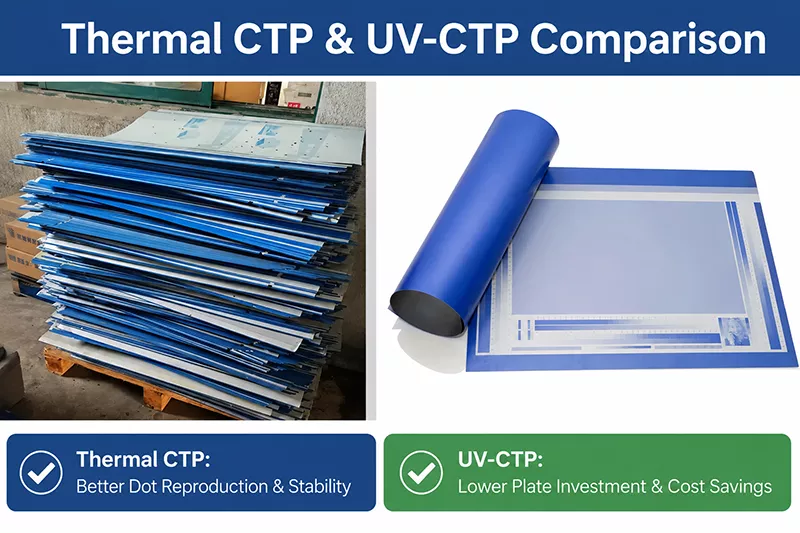
Two commonly discussed options are Thermal CTP plates and UV-CTP plates. Although both are used to transfer digital files directly onto offset printing plates, they differ in exposure technology, coating response, processing requirements, and production economics.
For printers, plate makers, and converters, the most practical question is not simply “Which plate is better?” It is: Which CTP plate technology fits your equipment, press conditions, job mix, and cost targets?
As a supplier of ctp aluminum plate substrate, Haomei Aluminum understands that the coating technology is only one part of plate performance. The aluminum base—its flatness, grain structure, anodic layer, cleanliness, and mechanical consistency—also has a direct impact on imaging quality and press life.
Choosing the right Computer-to-Plate (CTP) technology affects more than image quality. It can influence plate-making speed, operating cost, chemical consumption, press stability, and the type of jobs a printing company can handle efficiently.
What Is a Thermal CTP Plate?
A Thermal CTP plate is an offset printing plate that uses infrared laser imaging technology, most commonly with an 830 nm thermal laser wavelength. During exposure, the laser-generated heat changes the coating structure on the plate surface, forming the image and non-image areas required for offset printing.
Depending on the plate chemistry, thermal plates may use positive-working or negative-working technology. After exposure, the plate undergoes the corresponding processing method, such as conventional chemical development, low-chemical processing, or processless workflow, to prepare it for press production.
Due to its excellent imaging consistency and process stability, thermal CTP plate technology is widely applied in commercial printing, packaging, publishing, labels, newspapers, and other industries that require accurate reproduction and reliable plate performance.
Key Features of Thermal CTP Plates
- Compatible with mainstream 830 nm thermal CTP imaging systems
- Excellent dot reproduction for high-resolution printing and fine screen applications
- Stable performance during long production runs
- Strong resistance to changes in exposure and processing conditions
- Available in positive, negative, and processless plate technologies
- Suitable for commercial printing, packaging, and high-quality publication printing
In daily printing operations, thermal CTP plates are often selected by printers that prioritize consistent print quality, predictable production results, and reduced plate replacement caused by process variations.
What Is a UV-CTP Plate?
A UV-CTP plate is an offset printing plate designed for ultraviolet or violet laser imaging systems. Unlike thermal plates that rely on infrared heat, UV-CTP plates use shorter wavelength light energy to activate the photosensitive coating and create the required printing image.
The term UV-CTP can cover different ultraviolet imaging technologies. In many modern violet CTP systems, the imaging wavelength is commonly around 405 nm, depending on the CTP equipment design and plate formulation.
UV-CTP plates are widely recognized for their equipment cost advantages and efficient plate-making capability. They are commonly used by printing companies looking for a practical CTP solution with lower initial investment requirements.
Key Features of UV-CTP Plates
- Designed for UV, violet, or near-UV CTP imaging systems
- Lower equipment investment compared with some thermal CTP setups
- Fast imaging speed for efficient plate production
- Suitable for commercial printing, promotional materials, and short-to-medium print runs
- Available with different coating technologies for various workflow requirements
- Compatible with conventional and environmentally friendly plate processing options
For many small and medium-sized printing facilities, UV-CTP plates provide a cost-effective way to enter digital plate production while maintaining reliable offset printing performance.
Thermal CTP Plate vs UV-CTP Plate: Which One Is Better for Offset Printing?
Thermal CTP plates and UV-CTP plates are two widely used technologies in modern offset printing. Although both eliminate the need for traditional film-based plate making, they differ in laser technology, plate chemistry, operating requirements, and overall production cost.
The right choice depends on your printing environment, equipment investment, image quality requirements, production volume, and workflow preferences. The comparison below highlights the main differences between thermal CTP plates and UV-CTP plates to help printers select the most suitable solution.
| Comparison Item | Thermal CTP Plate | UV-CTP Plate |
| Laser Technology | Uses infrared thermal laser imaging, typically around 830 nm, to create the image through controlled heat energy. | Uses UV or violet laser exposure, commonly around 405 nm, to activate the photosensitive coating. |
| Plate Imaging Process | Heat-sensitive coating reacts during laser exposure, providing stable imaging performance and accurate dot reproduction. | Light-sensitive coating changes after UV exposure, with performance depending on plate chemistry and exposure control. |
| Printing Stability | Known for excellent consistency, especially in long production runs and applications requiring precise color control. | Provides reliable printing performance and works well for many commercial printing applications. |
| Light Handling Requirements | Many thermal plates offer convenient handling under normal workshop lighting conditions before imaging. | Some UV-CTP plates may require stricter control of ambient light depending on the plate type. |
| Equipment Investment | Thermal CTP systems generally require higher initial investment, but offer excellent long-term production stability. | UV-CTP equipment is often more economical and can be an attractive option for cost-conscious printing operations. |
| Imaging Efficiency | Provides stable imaging speed with consistent plate quality for high-volume commercial printing. | Offers efficient imaging performance, especially with modern violet CTP platesetters. |
| Image Resolution | Excellent fine detail reproduction, suitable for high-resolution printing and FM screening applications. | Delivers high-quality imaging performance when matched with compatible plates and equipment. |
| Press Performance | Commonly selected for medium to long print runs where durability and repeatability are important. | Suitable for short to medium runs, with long-run performance depending on plate grade and printing conditions. |
| Processing Options | Available in conventional processing, reduced-chemical processing, and processless CTP plate solutions. | Mainly uses processed plate systems, although available options vary by manufacturer and technology. |
| Common Applications | Widely used for commercial printing, packaging, publishing, and applications requiring high consistency. | Commonly used in commercial printing, regional printing, and cost-efficient short-to-medium production. |
Choosing between a thermal CTP plate and a UV-CTP plate should not be based only on the plate unit price. Factors such as platesetter compatibility, print volume, required image quality, processing method, and operating cost all influence the final production efficiency.
Thermal CTP plates are often preferred for printers looking for stable performance, excellent dot reproduction, and reliable long-run printing. UV-CTP plates can be a practical choice for businesses seeking lower equipment investment and flexible plate-making solutions.
Imaging Technology: Infrared Thermal vs. UV/Violet Light
The primary difference is the laser wavelength used by the CTP platesetter.
- Thermal CTP plates are imaged with infrared laser energy, commonly around 830 nm. The laser generates heat in the image area and changes the structure or solubility of the plate coating.
- UV-CTP or violet CTP plates use ultraviolet or violet laser exposure, typically around 405 nm for violet systems. Their photosensitive coating reacts directly to light at the required wavelength.
Quick comparison:
- Thermal CTP: infrared, heat-based imaging
- UV/Violet CTP: ultraviolet or violet light-based imaging
These systems are not interchangeable. A thermal plate must be used with a thermal platesetter, while a UV or violet plate requires compatible UV/violet CTP equipment. Before selecting a new plate supplier, always confirm the wavelength and plate compatibility of the existing CTP line.
Plate Handling and Light Sensitivity
Plate handling conditions can have a direct impact on production stability, especially in high-volume plate-making operations.
Many thermal CTP plates offer greater tolerance to normal plate-room lighting, although handling instructions vary by coating technology and supplier. This can simplify loading, unloading, and storage procedures while reducing the risk of accidental pre-exposure.
UV-CTP plates are generally more sensitive to ambient light. Depending on the plate type, a yellow-safe light environment or stricter light control may be required. Improper lighting can cause unwanted exposure, reduced image quality, processing inconsistency, or plate waste.
Thermal CTP may therefore be more convenient for operations with limited plate-room control. However, UV-CTP systems can deliver stable results when lighting, storage, processing, and operator procedures are properly managed.
Image Quality, Resolution, and Press Consistency
Both thermal and UV-CTP plates can produce high-quality offset printing plates. In practice, image quality depends on the complete plate-making and printing process rather than imaging technology alone.
Important factors include:
- CTP platesetter condition and laser calibration
- Plate coating formulation and sensitivity
- Plate processor settings and chemistry control
- Screen ruling, FM screening, and RIP workflow
- Ink and fountain solution balance
- Press maintenance and blanket condition
- Aluminum substrate flatness, graining, and anodizing quality
Thermal CTP plates are often selected for demanding applications requiring fine text, detailed halftones, smooth tonal transitions, stable color reproduction, or stochastic screening. Their imaging threshold can support consistent plate output in tightly controlled workflows.
UV-CTP plates are also capable of excellent commercial print quality. They are widely used for books, brochures, manuals, leaflets, forms, labels, and other short- to medium-run offset jobs where reliable performance and cost control are important.
In both cases, the aluminum substrate is the foundation of plate quality. A stable CTP plate base aluminum coil supports uniform electrochemical graining, consistent anodizing, reliable coating adhesion, and good water retention in non-image areas.
Processing Requirements and Chemical Consumption
Processing requirements vary by plate design. Traditional thermal and UV-CTP plates may require a developer, rinse water, and finishing gum. However, the thermal CTP market also includes low-chemical, chemistry-free, and processless plate options.
Processless or low-chemical thermal plates can help reduce processor maintenance, chemical consumption, water use, and wastewater treatment. They may also simplify plate-room operations, but their overall suitability depends on press conditions, run length, ink type, and operator experience.
Many UV-CTP plates continue to use conventional processing with developer and gum solution. This workflow is proven and widely available, but it requires regular control of developer activity, replenishment, processor cleanliness, and chemical disposal.
Run Length, Ink Compatibility, and Plate Durability
Thermal CTP plates are commonly used for medium- and long-run offset printing because many grades offer strong image durability and stable press behavior. Certain thermal plates can also be baked for extended run lengths or selected for demanding UV ink applications.
UV-CTP plates are frequently used for short- and medium-run production, although plate durability differs significantly between products. Some high-performance UV or violet plates can support longer runs when processing, baking, press setup, and ink compatibility are properly controlled.
When comparing expected press life, consider:
- Conventional ink, UV ink, LED-UV ink, or low-energy UV ink
- Paper, board, film, or other printing substrate
- Press speed and printing pressure
- Image coverage and solid ink density
- Fountain solution control
- Cleaning frequency and wash-up chemistry
- Whether plate baking is available
- Plate coating and anodic layer specification
Plate durability also depends on the aluminum base. Uniform thickness, clean surface quality, controlled roughness, and a stable anodized layer all contribute to better wear resistance and more consistent press performance.
Haomei Aluminum supplies aluminum sheet for printing plates for plate manufacturers that require stable material properties during graining, anodizing, coating, slitting, and finished plate production.
Equipment Investment and Total Operating Cost
UV/violet CTP systems have often been chosen by small and medium-sized print shops because the initial equipment investment can be lower than some thermal CTP configurations. For companies with an existing violet platesetter, continuing with compatible UV-CTP plates may be the most practical option.
Thermal CTP equipment may involve a higher initial investment, but it can provide advantages in workflow stability, automation, high-quality imaging, and access to processless or low-chemical plate technologies.
A realistic cost comparison should include the entire workflow:
Thermal CTP Cost Factors
- Thermal platesetter investment and service
- Thermal plate price
- Conventional, low-chemical, or processless workflow
- Developer, gum, water, and energy consumption
- Labor and plate-room handling requirements
- Processor maintenance and waste disposal
- Press startup time and paper waste
UV/Violet CTP Cost Factors
- CTP equipment investment and laser condition
- UV or violet plate price
- Developer replenishment and processor maintenance
- Safe-lighting and storage requirements
- Chemical consumption and disposal costs
- Potential waste caused by exposure or handling errors
A UV-CTP workflow may be highly cost-effective for standard short-run commercial printing. A thermal workflow may be more suitable for color-critical production, longer press runs, reduced chemical use, or operations seeking a more automated and stable plate-making process.
Aluminum Substrate Quality Is Critical for Every CTP Plate
Whether the final product is a thermal CTP plate or a UV-CTP plate, performance starts with the aluminum substrate. CTP plate production requires more than a coated aluminum sheet: the base material must perform consistently through cleaning, electrochemical graining, anodizing, hydrophilic treatment, coating, cutting, and printing.
A reliable lithographic aluminum substrate should provide:
- Consistent alloy composition
- Uniform thickness across the coil and sheet
- Good flatness and dimensional stability
- Stable tensile strength and elongation
- Clean surface with minimal scratches, oil marks, or inclusions
- Consistent electrochemical graining response
- Uniform anodizing performance
- Reliable coating adhesion
- Stable behavior during imaging and press operation
Inconsistent aluminum coil can lead to uneven graining, anodizing defects, coating problems, poor water retention, scratches, unstable imaging, and reduced plate life. For this reason, substrate consistency should be evaluated alongside plate coating and imaging performance.
Haomei Aluminum supplies aluminum lithographic plate substrate for PS plates, thermal CTP plates, UV-CTP plates, and other offset printing plate applications. Our materials are designed to help plate manufacturers maintain stable downstream processing and consistent finished plate quality.
Which Is Better: Thermal CTP or UV-CTP?
The choice between thermal CTP plates and UV-CTP plates depends on several factors, including CTP equipment type, required print quality, production volume, plate cost, and workflow preferences. Thermal plates are commonly preferred for demanding applications requiring excellent stability and fine image reproduction, while UV-CTP plates are often chosen where equipment investment and operating economy are important considerations.
Neither technology is universally better. The correct choice depends on the platesetter already installed, production volume, print quality requirements, ink system, environmental targets, and total operating cost.
Thermal CTP Plates May Be the Better Choice If You Need:
- High process stability and repeatable imaging
- Fine detail, smooth gradients, and demanding color work
- Medium- or long-run plate durability
- Processless or low-chemical plate-making options
- More flexible plate-room handling conditions
- Compatibility with a thermal CTP platesetter
UV-CTP Plates May Be the Better Choice If You Need:
- Compatibility with an existing UV or violet CTP system
- Lower initial equipment cost in many applications
- Efficient production for short- to medium-run work
- Reliable commercial print quality at controlled cost
- A proven conventional processing workflow
Questions to Ask Before Selecting a CTP Plate
- What imaging wavelength does the current platesetter use?
- What are the average and maximum print run lengths?
- Are conventional, UV, LED-UV, or low-energy UV inks used?
- Is a processless or low-chemical workflow required?
- Can the plate room provide controlled safe lighting if needed?
- What level of resolution, color consistency, and dot reproduction is required?
- What is the real cost per plate after chemicals, labor, maintenance, and waste disposal?
- Does the plate supplier use a stable, high-quality aluminum substrate?
Answering these questions will provide a more accurate basis for selection than comparing plate prices alone.
Need Aluminum Substrate for CTP Plate Production?
Haomei Aluminum supplies stable lithographic aluminum sheet and coil materials for Thermal CTP plates, UV-CTP plates, PS plates, and offset printing plate manufacturing applications.
Ask EngineerRegardless of the imaging system, dependable plate performance requires a high-quality aluminum base with uniform thickness, clean surface condition, controlled metallurgy, and stable electrochemical properties.
Users viewing this material also viewed the following
Further reading: thermal ctp platethermal ctppositive thermal ctp platectp thermal platectp thermaluv ctp plateuv ctp